

The Constitutional Amendment to Require a National Referendum To Declare War That Almost Happened
and it's still an option

This language came close to becoming an Amendment to the United States Constitution in January, 1938:
SEC. 1. Except in the event of an invasion of the United States or its Territorial possessions and attack upon its citizens residing therein, the authority of Congress to declare war shall not become effective until confirmed by a majority of all votes cast thereon in a nationwide referendum. Congress, when it deems a national crisis to exist, may by concurrent resolution refer the question of war or peace to the citizens of the States, the question to be voted on being, Shall the United States declare war on ________? Congress may otherwise by law provide for the enforcement of this section.
SEC. 2. Whenever war is declared the President shall immediately conscript and take for use by the Government all the public and private war properties, yards, factories, and supplies, together with employees necessary for their operation, fixing the compensation for private properties temporarily employed for the war period at a rate not in excess of 4 percent based on tax values assessed in the year preceding the war.
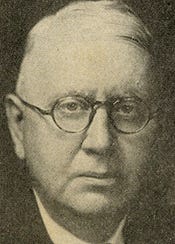
It’s known to history as the Ludlow Amendment, for its author, Congressman Louis Ludlow of Indiana. (Photo US House of Representatives)
How about that idea? Congress must ask We The People for permission to go to war, and private corporations can only profit from any such resulting war by a wonderfully austere 4%. Can you imagine the meltdown at the Wall Street Journal?
Why didn’t the Ludlow Amendment pass? The answer is who—President Franklin Delano Roosevelt. The social Democrat was also what might be called a liberal imperialist, and it is important to remember that he was taught in elite schools that white supremacy and eugenics were scientific facts.
FDR, good member of the upper class that he was, didn’t like the idea of giving The People the power to veto war, and he was convinced that the US would eventually have to go to war with Nazi Germany. This is well-known.
Anyway, in December 1937, during the Rape of Nanjing, the Japanese decided to bomb all the boats on the Yangtze River carrying both Chinese soldiers and civilians who were fleeing the massacre.
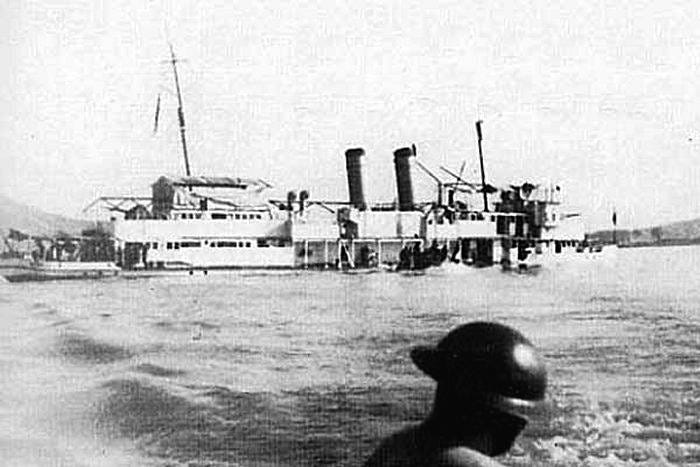
Japanese planes did their best to bomb and sink everything that floated. Their victims included the ancient gunboat USS Panay, and perhaps more importantly to some American elites, three Standard Oil tankers. (Below: The Panay sinking after the attack, file photo)
FDR seriously considered military action, but in the end decided against it for several reasons. One of them was that his congressional allies told him that if he used military force against the Japanese, then the Ludlow Amendment would pass the House of Representatives, and maybe the Senate.
At the time, public support for the amendment was hovering around 60%, as best the pollsters of the times could tell. It was still the Great Depression, and there was little appetite for war.
If the amendment had passed, it would not have stopped Congress from declaring war on Japan after Pearl Harbor, or after a Japanese attack on the Phillipines for that matter, so history probably would not have changed that much until after the war.
As it was, it carried a majority of the House, but not the required two-thirds majority, and never came up again.
But what if?
History would be very different. For starters, the Korean War may not have happened, which would make a whole lot of countries’ histories very different indeed, including China’s. Somewhere, in an alternate universe…but I digress.
I saw a clip of Congressman Ro Khanna saying we should force a Constitutional Convention to overrule the Supreme Court and banish all private money in our politics. I think that’s a good idea, but while we’re at it, I think resurrecting the Ludlow Amendment would be a positive thing indeed.
The Empire must die so a Republic which bears some semblance to the promise of the Declaration of Independence can finally be born.
Happy 4th of July, and whether you celebrate it or not, have a good day or night for you. And good luck, as always.
If you appreciate my scribbling, and can tolerate more emails, please consider becoming a free or paid subscriber at the lowest rates on Substack. You can also buy me a beer and receive no emails at all. Shares and likes mean much.
I love the idea to make war harder to start. Is the US in a war in Ukraine, or is providing weapons and financing a war a separate issue?
It's tricky trying to word legislation that doesn't have a loophole. The biggie, to me, is at minium overturning Citizens United. But how do we keep the lobbyists from literally writing the legislation and legislators willingly taking payoffs? Even if they become "illegal," there's almost always a workaround. Question for the ages: why do crooks rise to power? Enjoy the 4th. Just another day in paradise! (OB: hope your wife is home, at minimum recovering nicely, or better!)